Posts

Virtualising the Livery

Image
When I applied to join the Worshipful Company of Information Technologists in the winter of 2010 I made a decision to get involved in aspects of the Livery that were unconnected with my career in IT. This was partly because I wanted to do something new and challenging, and because I was very active in the professional body for the IT industry in the UK (BCS, The Chartered Institute for IT) I didn't need yet another extension to my career with IBM. The decision to get involved in something new led me to take an interest in the history, culture, customs, traditions, quirks and foibles of the City of London in general and the Livery Companies in particular. So far as is possible I've tried to keep my day job and my activities within the Livery untangled so the latter doesn't become an extension of the former. Occasionally my knowledge of IT and the digital realm has crossed over with the world of the Livery, most recently I co-delivered an event on Digital Heraldry at IT H...
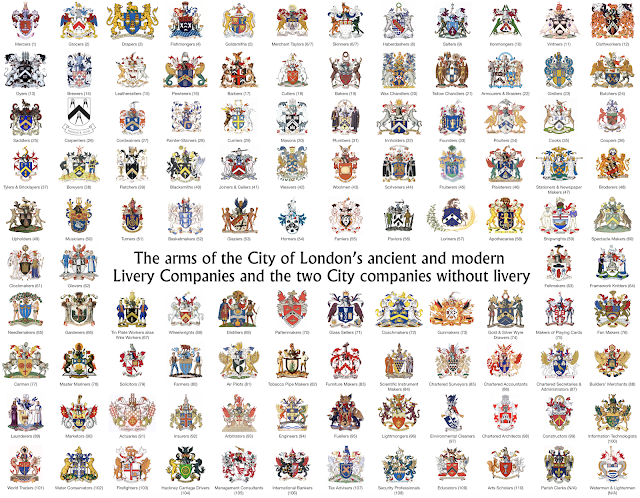
What exactly is a Livery Company?

Image
The tragic terrorist attack of Friday 29 th  November 2019 that took place within and outside Fishmongers’ Hall at the northern end of London Bridge threw a spotlight on that building and the organisation that owns it, but also more widely on these curious City of London institutions called Livery Companies. The events that took place in the hall and then spilled out onto the pavement caused a peak in interest on social media about the Fishmongers’ Hall, not least because of the heroism of the staff as reported by the Company's Clerk (Commodore Toby Williamson) on the BBC News. Social Media was alive with questions about whether the Fishmongers' Hall was a pub, a fishmonger's shop, perhaps even a fish and chip shop... it is none of those things. This blog seeks to explain what a Livery Company is (in the UK) for those who may wish to learn more. Reduced the simplest description a Livery Company is an occupational guild formed by Royal Charter, but that hardly helps expl...

Vote for Vellum! The 'roll' [sic] of parchment and vellum in preserving history and heritage

Image
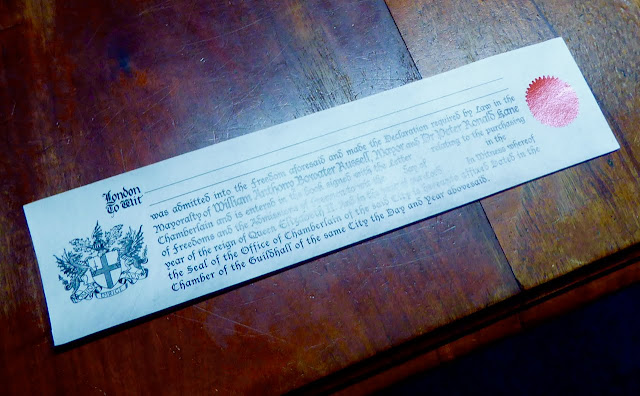
Every Freeman of the City of London receives a small certificate as the physical token of admission into the Freedom. In times past this document was carried in a wooden tube and had to be available for inspection, something akin to a license to trade. Most Freemen choose to have their Copy of Freedom (as it is described) framed by the Chamberlain's Court before they leave Guildhall. Because of this the Freemen rarely, if ever, handle the document to feel its texture, perhaps they assume it's just a piece of paper. A copy of Freedom of the City of London, ready for the final calligraphy work by the Chamberlain's Court in the City of London. This one prepared for a Freedom admission during the year of the 692nd Lord Mayor of London, William Russell Every Copy of Freedom is written on fine quality parchment rather than paper. The parchment is made from the skin of a sheep and is produced in the UK by William Cowley  of Newport Pagnell, Buckinghamshire (a f...

The City's Ward Clubs and their place in the 21st Century

Image
The Ward Clubs of the City of London are one of those curious creatures that exist only in the eco-system of the City and find no direct parallel anywhere else in the UK. Part social club, part residents' association, part platform for engagement with voters, and part fabric of the City's cultural heritage the Ward Clubs vary in age, size, vibrancy and engagement with the residents, workers, voters and institutions of their respective ward. This blog article explores the origins, role and relevance of the Ward Clubs in the 21st century, at a time when many (but not all) of them appear to have retired to comfortable obscurity as quiet social clubs for persons of a certain age, but perhaps they are needed more than ever to engage with the growing and changing City residential and working population. When did the Ward Clubs begin? The origins of the several of Ward Clubs may be found in early residents or rate payers associations, initially formed to keep down the rates in t...

The Art and Mistery of the Livery Companies - their role in trade, craft and profession

Image
How do the Livery Companies maintain their occupational links? A survey conducted within and among the Livery Companies during the Autumn of 2018 revealed that many members of the older Livery Companies view their company's role as primarily charitable with a supporting social dimension. While it is true to say that the Livery Companies are all heavily involved in charity it would be wrong to think the Livery has lost connection with trade, craft and profession or to dismiss them as dining clubs. It is a condition of formation of any new Livery Company that it must have a membership drawn from its chosen occupation, and the Court of Aldermen will want to see evidence that a majority of members are suitably qualified and active in the Company's field of endeavour before it progresses from Guild to Livery Company. Several of the Livery Companies impose strict membership criteria that ensure the Company remains rooted in its profession. Examples include the Chartered Account...