Posts

Showing posts with the label Alderman

The City's Ward Clubs and their place in the 21st Century

Image
The Ward Clubs of the City of London are one of those curious creatures that exist only in the eco-system of the City and find no direct parallel anywhere else in the UK. Part social club, part residents' association, part platform for engagement with voters, and part fabric of the City's cultural heritage the Ward Clubs vary in age, size, vibrancy and engagement with the residents, workers, voters and institutions of their respective ward. This blog article explores the origins, role and relevance of the Ward Clubs in the 21st century, at a time when many (but not all) of them appear to have retired to comfortable obscurity as quiet social clubs for persons of a certain age, but perhaps they are needed more than ever to engage with the growing and changing City residential and working population. When did the Ward Clubs begin? The origins of the several of Ward Clubs may be found in early residents or rate payers associations, initially formed to keep down the rates in t...

The traditions of the City of London and its Livery Companies

Image
The traditions of the City of London and its Livery Companies rival those of the Royal Household for their displays of pageantry and public spectacle, blending of the past with the present and sense of majesty that no other city can rival. The fact that more troops of the Crown participate in the annual Lord Mayor's Show than parade in the Sovereign's annual birthday parade (Trooping the Colour) illustrates the scale of the City's ability to put on a show. In fact the very word show when taken to mean a public spectacle derives from the requirement that the City's elected chief magistrate 'show himself' to the Monarch or his justices and swear allegiance, hence the Lord Mayor's Show. The early 20th century antiquarian and author Dr George Williamson captured the panoply of City ceremonial in Curious Survivals, a book presented to Queen Mary and now in the Royal Collection. The opening chapter of his comprehensive work on British customs and traditions read...

Get Chartered, or how to reach the Gold Standard of incorporated body with a Royal Charter

Image
This blog article is based on an interview I conducted with Keith Lawrey, winner of the City Livery Club's Root and Branch Award (2017). The Root and Branch Award recognises the Liveryman who has made an outstanding contribution to the wider aims of the Livery, and is usually presented by the Lord Mayor of London at the City Livery Club's annual civic luncheon in the City. Keith achieved his award for decades of pro bono work for the Livery Companies specifically guiding them through the process of obtaining a first Royal Charter, supplemental Royal Charters or making amendments to an existing Royal Charter. In 2020 I conducted a further podcast interview with Charles Hughes, Past Master of the Worshipful Company of Information Technologists. It was during Charles' year as Master that the Company's Royal Charter was presented. This article explores the reasons why a Livery Company would want to petition the Crown for a Royal Charter and the process as it stands to...

How to form a Livery Company - A Beginner's Guide

Image
Since the Norman Conquest of October 1066 the City of London has begotten more than one hundred Livery Companies. The current count of one hundred and ten is the highest since records began, and there are several prospective Livery Companies in the pipeline that will likely increase that count in the next decade. In the distant past some Livery Companies have failed, others have merged and at least two split apart (Bowyers and Fletchers). Putting aside the first nine hundred years of the growth of the Livery Companies, the past 70 years have witnessed an enormous increase in the formation of new companies. With the exception of the Master Mariners (achieved Livery status in 1932) and the Solicitors (Livery in 1944) all the 'Modern' Livery Companies have formed since 1952. Note well: Before we progress to the 'how' it is important to know that a Livery Company is a creature of the City of London, and may only be created by the Court of Aldermen. A Livery Company is c...

The role of the Beadle

Image
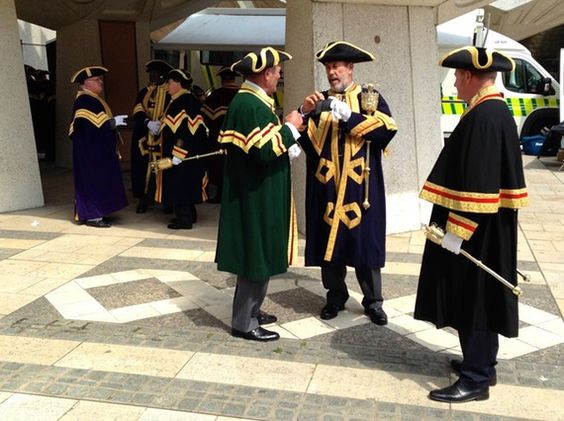
This blog article was update on 13 January 2024. The City of London has many civic and ceremonial officers that are unknown, or long since lost to the civic apparatus of other towns and cities throughout the United Kingdom. Ancient offices such as that of the Ale Conners, the Bridge Masters, the Chief Commoner, the Clerk to the Chamberlain's Court, the Secondary, and the Undersheriff are just a few among the panoply of robe wearing; sceptre, mace or sword bearing custodians of the City's traditions. The Beadle is the one office holder which is common to both the City of London Wards and to its many Livery Companies, yet in typical City style the role is not the same in every Company and certainly not between the Companies and the City. Such is the way of the City that delights in creating myriad exceptions to, and variations on, a common theme!  The role of Beadle probably grew out of the ecclesiastical role of Verger, and to this day the Verger of St Paul's Cathedral w...