Posts

Showing posts with the label Sheriff

The City Sheriffs and their Chain Gangs

Image
There's a new Sheriff in Town (well two actually) Any good cowboy and western film will feature that square jawed character who stands for law and order - the City Sheriff. In the wild west the Sheriff relied on his badge, his revolver, his horse, and a good dose of common sense to keep the peace. His office was usually next to the courthouse, and there were invariably cells for holding wayward townsfolk. This familiar trope of the spaghetti western finds it origins in the City of London where there are many parallels to be draw, but as ever the City of London likes to be different from other towns and elects two new Sheriffs to hold office every year, a right it has held since time immemorial. Who were the first Sheriffs in London? The office of Sheriff is undoubtedly the oldest in the City's vast treasure chest of ancient offices, it predates that of the Lord Mayor (1189), and the Aldermen (earliest record 1111). Its origins reach back before the Norman Conquest to Anglo-Saxo...

Nails, Knives and Horseshoes - a rent payment like no other

Image
The City of London is no stranger to quirky customs and ceremonies , no alien to ancient offices or the parading of artefacts from centuries past. The Ceremony of the Quit rents combines all these elements in an annual rite that has been conducted since at least the early 13th century; only the Coronation ceremony is older and that certainly does not happen annually.  In October of 2022 I was honoured to be invited to witness the ceremony as guest of one of the City's Sheriffs, Andrew Marsden, to whom I am most indebted for a privileged insight into this time-honoured tradition.  The Ceremony of the Quit rents is held every year at the Royal Courts of Justice, Kings Bench division, and presided over by the King's Remembrancer (not to be confused with the City Remembrancer) who is the last vestige of the Court of Exchequer and the oldest judicial office in the Kingdom.  Note: There is another, unrelated, Quit Rents ceremony for the Guildable Manor of Southwark. The King's ...

Vote for Vellum! The 'roll' [sic] of parchment and vellum in preserving history and heritage

Image
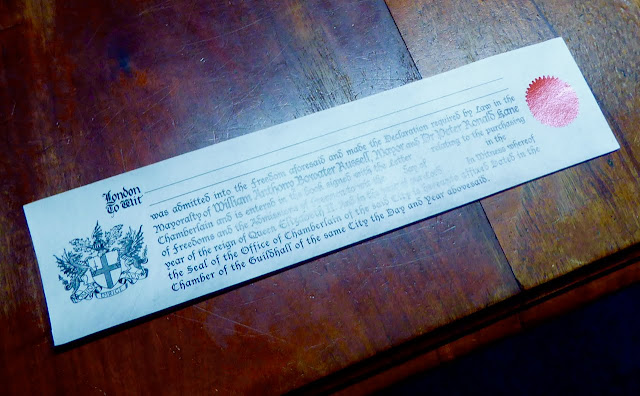
Every Freeman of the City of London receives a small certificate as the physical token of admission into the Freedom. In times past this document was carried in a wooden tube and had to be available for inspection, something akin to a license to trade. Most Freemen choose to have their Copy of Freedom (as it is described) framed by the Chamberlain's Court before they leave Guildhall. Because of this the Freemen rarely, if ever, handle the document to feel its texture, perhaps they assume it's just a piece of paper. A copy of Freedom of the City of London, ready for the final calligraphy work by the Chamberlain's Court in the City of London. This one prepared for a Freedom admission during the year of the 692nd Lord Mayor of London, William Russell Every Copy of Freedom is written on fine quality parchment rather than paper. The parchment is made from the skin of a sheep and is produced in the UK by William Cowley  of Newport Pagnell, Buckinghamshire (a f...

Please pass the Port

Image
Anyone who has attended a City of London civic or livery company banquet will be familiar with the numerous toasts that follow after the meal and before the speeches. These toasts are usually taken with port wine, or occasionally madeira. Quite when port became the wine of choice for toasts is unclear, but the custom is as well entrenched in the City as it is in the ward rooms and messes of HM Armed Forces, at Oxbridge Colleges, Masonic dinners and elsewhere. Port wine was originally, and very specifically, developed for the English palette and nowhere is it more popular than in Britain.  Britain's relationship with port began in the Georgian era. Prime Minister William Pitt the Younger was described as a 'three-bottle man' with port even being prescribed for his recurring bouts of gout. First a little history The history of port wine is inextricably linked with Britain's connection to Portugal and the numerous British families who developed the Douro wine region...