Posts

How to form a Livery Company - A Beginner's Guide

Image
Since the Norman Conquest of October 1066 the City of London has begotten more than one hundred Livery Companies. The current count of one hundred and ten is the highest since records began, and there are several prospective Livery Companies in the pipeline that will likely increase that count in the next decade. In the distant past some Livery Companies have failed, others have merged and at least two split apart (Bowyers and Fletchers). Putting aside the first nine hundred years of the growth of the Livery Companies, the past 70 years have witnessed an enormous increase in the formation of new companies. With the exception of the Master Mariners (achieved Livery status in 1932) and the Solicitors (Livery in 1944) all the 'Modern' Livery Companies have formed since 1952. Note well: Before we progress to the 'how' it is important to know that a Livery Company is a creature of the City of London, and may only be created by the Court of Aldermen. A Livery Company is c...

Ancient Livery Companies and their role in the 21st Century

Image
The City of London's Livery Companies represent an immense range of trades, crafts and professions. Some companies such as the Butchers and Carpenters were probably active prior to the Norman Conquest, others such as the Air Pilots and Information Technologists are creatures of the 20th century. What they all have in common are roots in a particular occupation whether it be ancient or modern. For most companies the occupational links remain strong even if the particular craft, such as that of the Bowyer or the Wheelwright, is no longer a major field of employment. Are these companies still relevant in the 21st century? All too often public awareness of the Livery Companies is limited to the floats in the Lord Mayor's Show or photos on social media of white tie banquets in the City. This can reinforce the erroneous perception that the Livery Companies are fancy dining clubs with no substantive role in trade, craft or profession. Freemen and Liverymen will know that the reali...

The role of the Beadle

Image
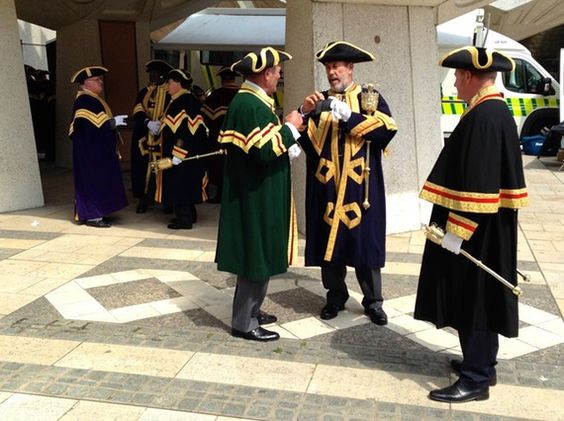
This blog article was update on 13 January 2024. The City of London has many civic and ceremonial officers that are unknown, or long since lost to the civic apparatus of other towns and cities throughout the United Kingdom. Ancient offices such as that of the Ale Conners, the Bridge Masters, the Chief Commoner, the Clerk to the Chamberlain's Court, the Secondary, and the Undersheriff are just a few among the panoply of robe wearing; sceptre, mace or sword bearing custodians of the City's traditions. The Beadle is the one office holder which is common to both the City of London Wards and to its many Livery Companies, yet in typical City style the role is not the same in every Company and certainly not between the Companies and the City. Such is the way of the City that delights in creating myriad exceptions to, and variations on, a common theme!  The role of Beadle probably grew out of the ecclesiastical role of Verger, and to this day the Verger of St Paul's Cathedral w...

The City's relationship with the Armed Forces

Image
The City of London has a particularly close and long-standing relationship with the Armed Forces of the Crown, one that continues to flourish in the 21st century through the City's privileged corps / regiments and the plethora of Livery Company affiliations with ships, shore stations, regiments, squadrons and other military formations. This is all the more surprising when one considers that  from a legal perspective, the City of London seems rather unwelcoming to the military.  The City is the only place in the Kingdom where Her Majesty’s Forces may not enter without the prior permission of the Lord Mayor having been sought and obtained. Even HM's Lord Lieutenant for Greater London may not enter the City in uniform without the permission of the Lord Mayor. This right to refuse troops of the crown entry to the City is codified in a Royal Charter presented to the City by Edward III in 1327 and last tested in court as recently as 1842 (in City terms that’s very recently). Du...